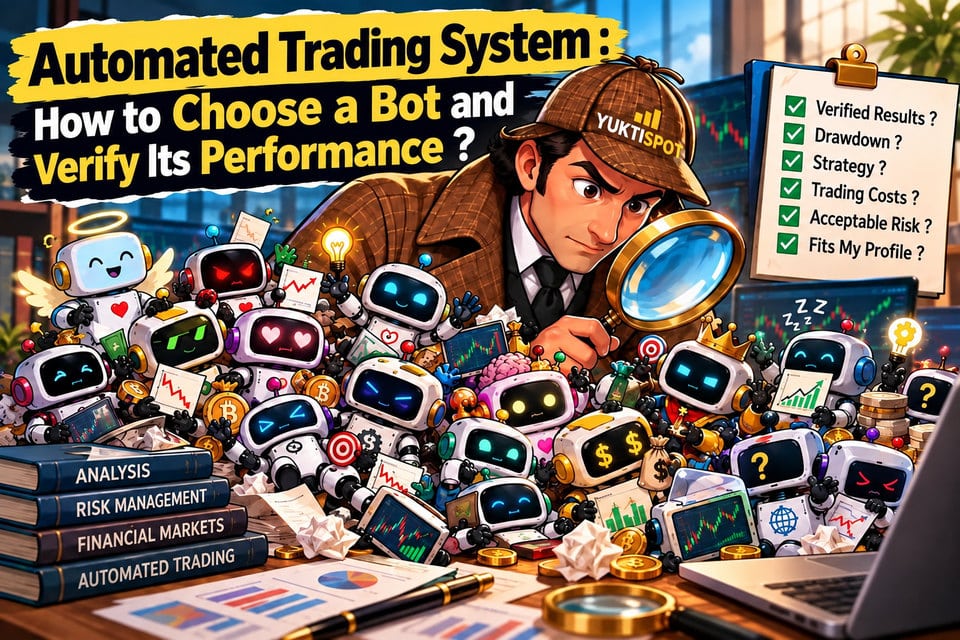
Have you ever wondered which automated trading bot is actually the best on the market?
With hundreds of trading bots promising impressive returns, high win rates, and artificial intelligence-powered strategies, finding a reliable automated trading system can quickly become overwhelming.
Our October 2026 research highlights an important reality: no trading bot can reasonably be called the best simply because of its advertised performance.
A bot claiming an 80% win rate or spectacular returns is not necessarily a good investment. Behind those attractive numbers may be substantial risks, significant losses, or results achieved under conditions that ordinary traders cannot reproduce.
Before choosing an automated trading system, we need to distinguish between two things:
- The best ready-to-use trading bot: a system whose strategy, actual performance, risks, and costs are sufficiently transparent to allow meaningful verification.
- The best trading bot for your needs: a system that matches your preferred markets, available capital, risk tolerance, and trading objectives.
These are not necessarily the same.
A trading bot suitable for an experienced trader with $10,000 in capital could be completely inappropriate for a beginner starting with $300.
So how can we separate reliable trading systems from attractive marketing promises?
And more importantly, how can we verify their performance before putting our money at risk?
What Is an Automated Trading System and How Does It Work?
An automated trading system is software designed to execute trades according to predefined rules without requiring the trader to manually place every order.
These rules may be based on technical indicators, price movements, market volatility, mathematical models, or other measurable conditions.
For example, a trading system might automatically open a buy position when specific indicators signal an upward trend, then close that position when a predefined profit target or stop-loss level is reached.
The main components of an automated trading system typically include:
- Entry rules: the conditions that trigger a trade.
- Exit rules: when and how positions are closed.
- Position sizing: how much capital is allocated to each trade.
- Risk management: stop-loss levels, maximum exposure, and loss limits.
- Execution: how orders are transmitted to the broker.
- Monitoring: how traders track performance and identify problems.
On MetaTrader 5, automated trading programs are commonly called Expert Advisors, or EAs.
Other platforms support different forms of trading automation, including custom algorithms, API-based trading systems, and rule-based strategies.
Although the terms automated trading system and trading bot are often used interchangeably, the system can encompass the entire trading process, while the bot is the software executing the strategy.
Automation offers an important advantage: it can apply predefined rules consistently without being directly influenced by fear, impatience, or excitement.
However, automation does not eliminate market risk.
A poorly designed strategy can lose money just as efficiently as a well-designed strategy can execute trades.
That is why understanding how a system works matters more than simply knowing how much profit it claims to generate.
What Our 2026 Trading Bot Research Reveals
Rather than limiting our research to trading platforms such as MetaTrader, ProRealTime, or cTrader, we decided to examine specific automated trading bots.
We reviewed several rankings and independent analyses published in 2026.
The findings raise important questions about the reliability of advertised trading performance.
Three trading bots worth examining
| Trading bot | Findings from published analyses | YuktiSpot assessment |
|---|---|---|
| Smart Robot AI | Featured at the top of a ranking, with 13 months of reported live results, an advertised 29% annualized return, and 11% drawdown. | Worth further investigation, but these figures have not been independently verified by YuktiSpot. |
| Forex Flex EA | An independent review reports three real-money accounts, two of which lost more than 90%. | Serious warning signs. We would exclude this bot from consideration at this stage. |
| Forex GOLD Investor | An independent review reports a 46.67% drawdown on a real-money account, substantially higher than the drawdown presented in its backtest. | A major warning sign regarding the actual level of risk. |
These observations come from published third-party analyses. They are not the results of independent tests conducted by YuktiSpot.
The underlying trading histories, observation periods, and execution conditions must be considered before drawing conclusions.
Hidden risks are not always easy to identify
An October 8, 2026 report examining 801 products listed on the MQL5 marketplace identified two particularly revealing findings:
- 19% of the products examined were classified as using confirmed martingale strategies.
- 25% were classified as having no verifiable ceiling on potential losses under the report’s methodology.
These percentages apply only to the 801 products examined. They should not be interpreted as representative statistics for every trading bot available worldwide.
Nevertheless, they illustrate a fundamental problem: some of the most important risks are not immediately visible in marketing materials or performance charts.
A trading bot being listed on a marketplace such as MQL5 does not, by itself, guarantee profitability or safety.
Which automated trading bot should you buy?
At this stage of our research, none of the bots examined can be recommended without further analysis of its actual trading history. An advertised return, an impressive win rate, or a top position in a ranking is not enough.
Before committing capital to an automated trading system, we need clear answers to several questions:
- Are the results based on a real-money account or a simulation?
- What was the maximum recorded drawdown?
- Does the bot use martingale, grid trading, or significant leverage?
- Do the reported returns include spreads, commissions, and other trading costs?
- Does the seller provide a complete enough trading history to verify the claims?
- Is the strategy appropriate for our capital and acceptable level of risk?
Without this information, purchasing a trading bot becomes more an act of faith in a marketing promise than an informed investment decision.
The real question is no longer simply: Which trading bot should I buy?
It becomes: How can I determine whether an automated trading system actually deserves my trust?
How to Audit an Automated Trading System Before Buying
When a seller claims that a trading bot has generated returns of 30%, 50%, or even 100%, our first reaction should be to ask one simple question:
Can you show us exactly how those results were achieved?
A return figure presented on its own tells us very little. A trading bot may display an impressive growth curve while taking enormous risks. It may also perform exceptionally well on historical data, only to fail when market conditions change.
The CFTC’s guidance on trading systems also recommends distinguishing hypothetical performance from actual trading results and seeking independent verification before purchasing a system.
To evaluate an automated trading system properly, we need to examine the evidence before believing the promises.
1. Understand the difference between backtesting and live trading
Backtesting involves running a trading strategy against historical market data to observe how it would have performed. MetaTrader 5 includes a Strategy Tester that allows traders to simulate Expert Advisor operations, adjust parameters, and compare results.
This is a useful tool, but it has one fundamental limitation:
Strong historical performance does not prove that a trading bot will be profitable in the future.
Several elements deserve particular attention:
- Testing period: a few favorable months are not enough to demonstrate the robustness of a strategy.
- Execution conditions: spreads, commissions, slippage, and historical data quality can significantly affect results.
- Strategy parameters: were they optimized excessively to produce attractive historical returns?
- Market conditions: did the system experience high volatility, sustained trends, and sideways markets?
Another important precaution is to test the strategy on data that was not used during optimization. This is known as out-of-sample testing. It helps identify strategies that may have been over fitted to historical market conditions.

YuktiSpot Tip
Do not automatically reject a trading bot because its seller provides backtests. However, never treat simulated results as sufficient evidence of real-world profitability.
2. Demand real and verifiable trading performance
Imagine a seller presents an automated trading system that has generated a 40% return on a live account. That is certainly more interesting than a backtest alone. But several questions remain unanswered.
How long has the account been operating?
How many trades were executed?
How much capital was involved?
Are unrealized losses visible?
Do the results correspond to the exact version of the bot being sold?
Services such as Myfxbook allow traders to examine trading histories and verify certain aspects of account authenticity.
However, we must distinguish between two concepts.
A verified trading history means that the displayed trading data meets the verification procedures of the service concerned.
A reliable trading strategy requires a much broader assessment, including the observation period, risk exposure, consistency, execution conditions, and reproducibility.
In other words, a verified account can still experience substantial losses.
Verification establishes something about the authenticity of the record. It does not establish that the strategy is safe or profitable.
YuktiSpot Tip
Request a detailed, up-to-date trading history, preferably accessible through an independent third-party service, rather than relying on a screenshot showing an attractive profit curve.
3. Examine drawdown before profitability
Drawdown is one of the most important indicators for understanding the risk associated with an automated trading system. It measures the decline from a previous account peak to a subsequent low. Consider the following example:
A trading account starts with $5,000. Its value increases to $6,000 before falling to $3,600. The decline from $6,000 to $3,600 is $2,400. That represents a 40% drawdown. But here is the important part:
To recover from $3,600 to the previous $6,000 peak, the account must generate a return of approximately 66.7%. This asymmetry explains why large losses can be so difficult to recover.
It is also important to distinguish between:
- Balance drawdown: calculated using the account balance after closed trades.
- Equity drawdown: calculated using account equity, including unrealized profits and losses.
A trading bot may display a relatively stable balance while holding several positions with substantial unrealized losses. This is especially important when evaluating grid or martingale strategies.
Even an automated trading system with an attractive performance history can suffer serious losses if its position sizing and risk settings are unsuitable for the available capital.
YuktiSpot Tip
Always investigate the maximum drawdown, how it was calculated, and how account equity evolved over time. High returns do not automatically justify excessive risk.
4. Identify strategies that can amplify losses
Some automated trading strategies carry particular risks. Two important examples are martingale and grid trading.
Martingale strategies
In some trading applications, martingale involves increasing position sizes after losses in an attempt to recover previous losses. This approach can produce a series of small gains while exposing the account to increasingly large losses when the market moves unfavorably.
Grid trading strategies
A grid system opens multiple positions at different price levels. Grid trading is not necessarily dangerous in every configuration. However, it can become extremely risky when losing positions accumulate without adequate exposure limits.
Both approaches may produce long sequences of winning trades, creating the appearance of consistent profitability. The danger becomes apparent when a prolonged market movement generates losses that the available capital can no longer support.
Before purchasing an automated trading system, ask:
- Does the bot automatically increase lot sizes after losses?
- How many positions can it open simultaneously?
- Does it impose a maximum total exposure?
- Does it use a clearly defined stop-loss mechanism?
- What happens when the market moves beyond the scenarios anticipated by the strategy?
YuktiSpot Tip
If a seller refuses to explain how the system manages risk, consider that lack of transparency a significant warning sign.
5. Calculate the true cost of an automated trading system
The purchase price is only one part of the total cost of automated trading. A bot advertised for $300 may ultimately cost considerably more if it requires subscriptions, a virtual private server (VPS), or specific execution conditions.
Trading costs must also be considered:
- Spreads
- Broker commissions
- Slippage
- Overnight financing charges
- VPS hosting
- Software subscriptions or license renewals
Consider a bot executing 500 trades per month. If execution costs are just $0.40 higher per trade than those used in the advertised results, that represents an additional $200 per month. For a small trading account, these expenses can consume a significant portion of potential profits.
This is why the same automated trading system may produce different results depending on the broker, account type, and trading conditions.
As FINRA warns about automated trading services, some unregistered providers advertise unrealistic returns or supposedly risk-free strategies, making independent research essential before committing capital.
YuktiSpot Tip
Compare performance after all costs and verify that the strategy remains viable under your broker’s actual execution conditions.
The YuktiSpot Method: Six Criteria for Evaluating Trading Bots
Faced with these challenges, we developed a comparative evaluation method based on six criteria. Our objective is not to predict which automated trading system will generate the highest returns tomorrow.
Instead, we want to help traders compare available information, identify potential risks, and recognize where further verification is necessary.
Our 100-point evaluation framework
| Evaluation criterion | Maximum score | What we examine |
|---|---|---|
| Performance and supporting evidence | 25 | Trading history, observation period, and quality of supporting records |
| Risk management | 25 | Drawdown, exposure, loss limits, and protective mechanisms |
| Transparency | 15 | Information about the strategy, developer, and reported results |
| Robustness | 15 | Testing diversity and apparent resilience across market conditions |
| Costs | 10 | Purchase price, subscriptions, and operating expenses |
| Support and documentation | 10 | Customer support, documentation, and terms of use |
| Total | 100 | YuktiSpot comparative assessment |
This framework does not turn marketing information into independently verified evidence. An automated trading system may receive a relatively high score because its documentation, transparency, or risk management features appear stronger than those of competing products.That does not mean its future profitability has been established.
For this reason, our evaluations also distinguish between the quality of available evidence and the limitations of each assessment. A YuktiSpot score should be understood as a structured editorial comparison, not a guarantee of returns or an investment recommendation.
Compare 50 Trading Bots with YuktiSpot

To make this evaluation method more accessible, we have developed a trading robot comparison tool featuring 50 automated trading bots assessed according to our six criteria.
The tool allows traders to:
- Search for a specific trading bot.
- Compare evaluation scores.
- Examine prices and supported markets.
- Identify reported risk levels.
- Review individual bot profiles.
- Compare available information using a consistent methodology.
Our database is not presented as a definitive list of the 50 best trading bots on the market. It is a collection of products examined through a common analytical framework, designed to be expanded and updated over time.
The comparison tool is a starting point for research. It does not replace an independent audit of actual transactions or personal testing under controlled conditions. And even when a bot looks promising on paper, an important question remains:
How can we determine whether its results will resemble those we experience on our own trading account?
How to Choose a Trading Bot That Fits Your Profile
This is where things become more complicated.
Between trading bots promising spectacular returns, systems advertising win rates of 80% or 90%, and products marketed as revolutionary because they use artificial intelligence, it can be difficult to know which claims deserve attention.
Suppose we find an automated trading system with a credible trading history. Is that enough reason to buy it?
Not necessarily.
A bot may be appropriate for someone trading with $10,000 but far too risky for someone starting with $300.
Consider two hypothetical trading bots.
| Performance indicator | Trading Bot A | Trading Bot B |
|---|---|---|
| Return | 12% | 30% |
| Maximum drawdown | 8% | 40% |
Which would you choose?
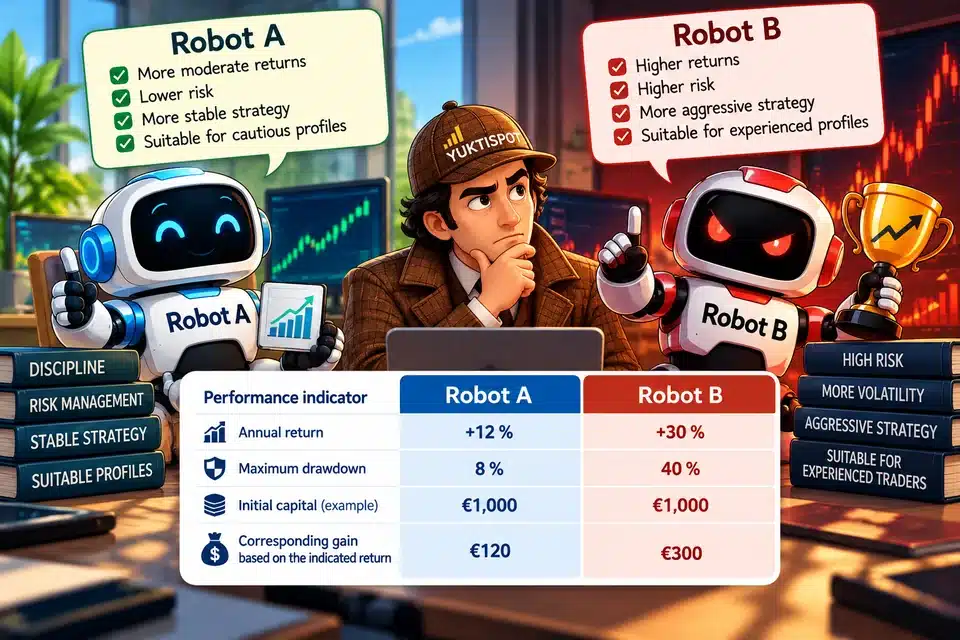
At first glance, Bot B looks more attractive because of its higher return. But its historical drawdown is also substantially larger.
A trader using Bot B would have needed to tolerate a much deeper decline in account value.
For someone with limited capital or a low tolerance for losses, Bot A might be the more appropriate choice, assuming the underlying evidence and other conditions are comparable.
The best trading bot is not necessarily the one generating the highest advertised returns. It is the one whose strategy, risk exposure, operating requirements, and costs are compatible with your circumstances. This also means considering the markets you intend to trade.
A system developed specifically for gold trading may behave very differently from a bot designed for major Forex currency pairs.
Likewise, a high-frequency scalping strategy may depend heavily on execution speed and low spreads, while a longer-term strategy may be more sensitive to overnight financing costs. Before selecting an automated trading system, we should therefore understand not only what it trades, but also how and under which conditions it operates.
Can You Trust Your Automated Trading System?
Imagine that we have finally found a trading bot that appears to meet almost all our requirements. Its price fits our budget. Its strategy seems understandable. Its trading history is available. And its risk level appears acceptable. Can we simply buy it and let it trade?
Not so fast. There is still an important difference between the results presented by a seller and those we might obtain on our own account. A bot can perform well with one broker and significantly worse with another.
Spreads, execution speed, slippage, account specifications, and software settings can all affect trading performance.
This is particularly relevant for automated trading strategies that depend on small price movements or rapid order execution. So why not take the time to test the system ourselves?
But technical performance is only part of the equation. Even when a bot executes trades without fear or hesitation, someone still has to decide how much capital to risk, when to intervene, and when to stop the system altogether.
Automation removes certain emotional decisions from trading, but it doesn’t remove the trader’s responsibility. This is why understanding trading psychology and risk management remains essential, even when using an automated trading system.
And before entrusting our money to a robot, shouldn’t we first see how it behaves under our own trading conditions? So why not take the time to test the system ourselves?
Why not start with a demo account?
A demo account is one of the most accessible precautions available to traders. On MetaTrader 5, it allows us to run an Expert Advisor without immediately risking real money.
We can observe how the automated trading system behaves:
- How many positions does it open?
- Does it respect its risk management rules?
- How does it respond to increased volatility?
- Does it operate as described by the seller?
However, demo accounts do not always reproduce the execution conditions of live accounts accurately. They are primarily useful for checking functionality and identifying potential problems before considering live trading.
For meaningful testing, try to reproduce your intended trading conditions as closely as possible. Use the same broker where practical, the same financial instrument, identical strategy parameters, and a virtual account balance similar to the amount you plan to invest.
And most importantly, avoid drawing conclusions after just three profitable trading days. A bot that performs well for one week has not yet demonstrated long-term reliability.
How to Measure Trading Bot Performance Beyond the Win Rate
Now suppose our automated trading system has executed 100 trades. Of those trades, 80 were profitable. An 80% win rate sounds impressive. But does it actually prove that the strategy is profitable?
Absolutely not.
Consider this example:
| Trading results | Calculation | Total |
|---|---|---|
| 80 winning trades | 80 × $10 | +$800 |
| 20 losing trades | 20 × −$50 | −$1,000 |
| Net result | −$200 | |
| Win rate | 80% |
Despite winning 80% of its trades, the system has lost $200 before trading costs. Conversely, a bot with a win rate of just 45% can be profitable if its average winning trades are sufficiently larger than its average losing trades. That is why we need to look beyond the percentage of winning trades.
Net profit, average gain, average loss, drawdown, trading costs, and account equity provide a much more complete picture.
And fortunately, analyzing these indicators does not require manually copying every transaction into an Excel spreadsheet.
How to Analyze Automated Trading Performance with MT5
What if we could analyze our MetaTrader 5 trading history directly? That is precisely why we developed the free YuktiSpot Trading Journal.
The idea is simple: import your MT5 transaction history and examine the results to understand what is working and what needs attention.
Exporting your trading history from MetaTrader 5
The process is straightforward:
- Open the History tab in MetaTrader 5.
- Right-click directly on the displayed transactions.
- Select the period you want to analyze.
- Right-click the transactions again.
- Select Report → HTML to export the trading report.
The resulting HTML file can then be imported into the YuktiSpot analysis tool. Instead of relying exclusively on a profit curve, you can examine your trading results in a more structured way. This makes it easier to identify patterns, evaluate performance, and recognize areas requiring further investigation.
There is, however, an important limitation to remember. A history of closed trades does not necessarily reveal the full risk exposure experienced while those positions were open. For a more complete assessment of an automated trading system, we must also monitor account equity and open positions.
A trading journal is therefore a valuable analytical tool, but it does not replace ongoing risk monitoring.
Frequently Asked Questions About Automated Trading Systems
What is an automated trading system?
An automated trading system is software that executes trades according to predefined rules. It can analyze market conditions, open and close positions, and apply risk management settings without requiring manual execution of every trade.
Do automated trading systems really work?
Automated trading systems can execute trading strategies effectively, but their profitability depends on the quality of the strategy, market conditions, execution costs, and risk management. Automation does not guarantee profitable results.
How much money do I need to start automated trading?
There is no universal minimum. Capital requirements depend on the market, broker, contract sizes, leverage, and strategy. A system suitable for a $10,000 account may expose a $300 account to unacceptable risk.
How can I verify a trading bot’s performance?
Examine a detailed trading history, preferably from a verifiable real-money account. Review maximum drawdown, account equity, trading costs, average gains and losses, and the period over which results were achieved.
Are automated trading systems safe for beginners?
Automated trading systems can be used by beginners, but they still require an understanding of trading risk, leverage, and position sizing. Testing on a demo account and understanding the strategy are important precautions before risking real capital.
Can I use an automated trading system with MetaTrader 5?
Yes. MetaTrader 5 supports automated trading through Expert Advisors. Traders can backtest strategies using its Strategy Tester and run compatible EAs on demo or live accounts, subject to broker and account restrictions.
What If the Best Trading Bot Is the One You Understand Best?
At the beginning of our research, we wanted to answer a seemingly simple question: What is the best automated trading bot on the market?
But as our investigation progressed, the answer became much less obvious. One bot may advertise spectacular returns while exposing traders to excessive risks. Another may deliver more modest results but offer a better-documented strategy and more appropriate risk controls.
And even when an automated trading system has a credible trading history, there is no guarantee that it will reproduce those results in the months ahead. Does that mean we should abandon automated trading?
Certainly not.
Automation can offer genuine advantages. It can apply trading rules consistently, execute orders quickly, and reduce certain impulsive decisions. But it cannot turn a poor trading strategy into a good one. It does not eliminate losses. And it does not remove the need to understand how our money is being managed.
The goal should not be to find a robot that promises to make money for us. It should be to identify an automated trading system whose operation, performance, and risks we can understand, verify, and monitor.
That is the philosophy behind the YuktiSpot tools: a trading bot comparison platform to support informed selection and a free trading journal to help analyze actual results.
And if there is one lesson worth remembering from our research, it is this:
Before asking how much an automated trading system can earn, ask how much it could lose, why those losses might occur, and how you can verify the risks.
Because in automated trading, just as in manual trading, performance is not measured by profits alone. It must also be evaluated in relation to the risks taken to achieve them.