
You know your strategy. Your setup is there. Your stop is defined.
Then the market moves — and so does your trading psychology.
Do you close winning trades too early because you are afraid of losing the profit? Chase a move because of FOMO? Try to recover immediately after a loss? Or become overconfident after several winning trades?
Even a solid trading strategy can become difficult to follow when emotions start influencing your decisions.
Knowing that emotions influence trading decisions is easy. The real question is: what can you actually do when they take control?
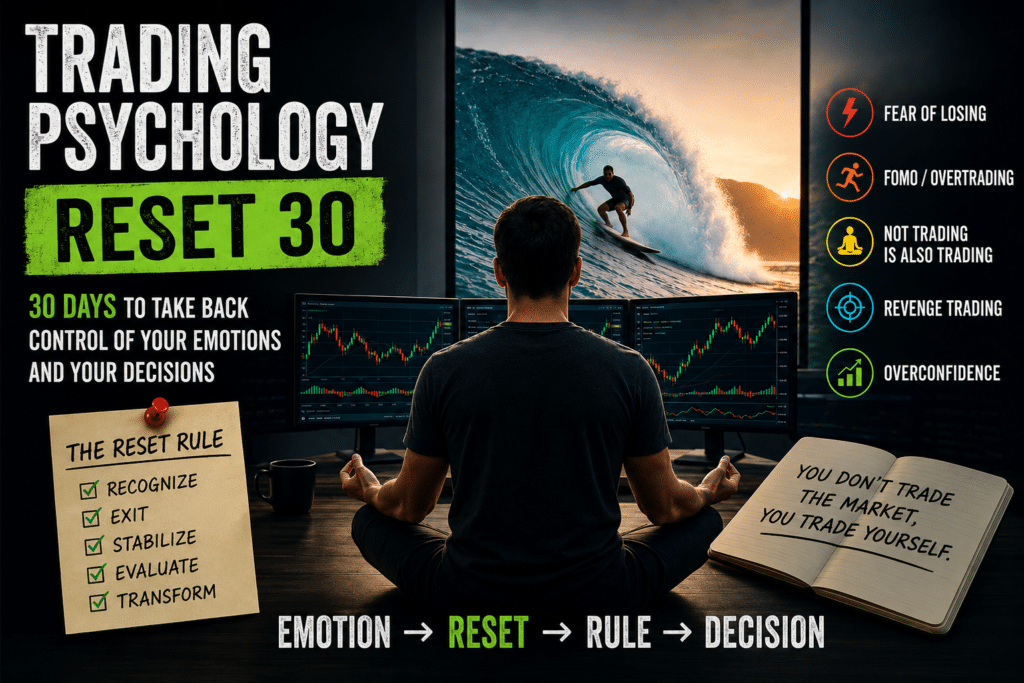
RESET 30 is a practical 30-day protocol designed to help traders identify their emotional triggers, interrupt impulsive reactions and replace them with predefined rules.
No miracle method. No promise to eliminate emotions.
You observe. You test. You measure. Then you keep what works for you.
What Is Trading Psychology?
Trading psychology refers to the emotions, habits and mental reactions that influence your decisions in the market. Understanding your trading psychology means recognizing when these emotions begin to influence your decisions.
Fear can make you close too early. FOMO can make you chase a move. Frustration can lead to revenge trading, while a winning streak can create overconfidence and encourage excessive risk.
The problem is not having emotions. The problem begins when an emotion starts making the decision for you.
That is where RESET comes in.
What Does RESET Mean?
When an emotion rises, don’t try to suddenly become more rational. Interrupt the reaction:
R — Recognize
Fear? FOMO? Frustration? Euphoria? An urge to recover a loss?
E — Exit
Hands off the mouse. No impulsive order.
S — Stabilize
Breathe, move, or step away from the screen for a moment.
E — Evaluate
Return to the facts. Is your setup still valid? Has the market actually changed?
T — Transform
Apply the rule you prepared for that situation.
The principle is simple:
EMOTION → RESET → RULE → DECISION
RESET 30 turns this sequence into a habit you practice for 30 days.
Fear of Losing? Accept the Loss Before You Trade
Losses are part of trading.
The danger often begins when a trader refuses to accept one:
“I’ll wait a little longer.”
“It will come back.”
“I’ll take another trade to recover.”
A manageable loss can then become a serious one.
Before entering a trade, ask yourself:
How much can I lose on this trade without changing the way I think?
Define that limit before entering. If it is reached, the trade is over.
Your RESET rule might be:
IF my predefined maximum loss is reached → THEN I accept the loss. No rescue trade. No revenge trade.
Accepting a loss does not mean abandoning risk management. It means accepting the possibility of losing before your emotions have something to negotiate.
Closing Winners Too Early? Ask Why
A trade turns profitable and suddenly you want to close it.
But has the market changed — or are you simply afraid of losing your unrealized profit?
This distinction matters.
Closing because you are afraid → emotion.
Closing because market conditions changed → adaptation.
Your trading plan should provide structure without becoming a prison.
When you feel the urge to exit, RESET and ask:
Has my scenario actually weakened, or am I reacting to fear?
Sometimes the best decision is to step away from the screen and give the trade room to develop.
FOMO and Overtrading: Think Like a Surfer
FOMO is one of the most common trading psychology challenges because it creates a sense of urgency where none may exist.
A move starts without you. Price accelerates.
“I need to get in now!”
That is FOMO, and it can quickly become overtrading.
Think like a surfer. A surfer does not jump onto every wave because it might be the last one. They observe, wait and choose.
Missed one?
Another wave will come.
Markets work the same way. Your job is not to catch every movement. It is to remain neutral enough to recognize the opportunities that fit your strategy.
Your RESET rule:
IF I start chasing the market → THEN I place no order until a valid setup appears.
Missing a trade is better than losing your discipline.
Revenge Trading: Don’t Trade Your Previous Loss
A stop is hit.
Almost immediately, a thought appears:
“I’ll make it back.”
STOP.
You may no longer be trading the market. You are trading your loss.
Step away from the screen. Walk, breathe and interrupt the reaction before making another financial decision.
Research on slow breathing has found associations with autonomic and psychological changes related to relaxation and emotional regulation.
slow breathing techniques can therefore be one simple component of the Stabilize step — not as a trading strategy, but as a way to create distance before another decision.
Then ask:
Is my next trade based on a valid setup, or am I trying to recover the previous one?
If the answer is recovery, don’t trade.
Winning Can Affect Trading Psychology Too
Three successful trades can be just as dangerous psychologically as three losses.
You feel confident. Everything seems easy. Then comes:
“Maybe I should increase the position size.”
The market does not know that you just won three trades. Your next setup is not better because the previous three worked.
Decide your maximum position size before the session.
RESET rule:
IF I have an exceptional gain or a winning streak → THEN my maximum position size remains unchanged until the next session.
Confidence can help. Euphoria can distort risk.
Stop Trying to “Be Disciplined”: Program Your Reaction
Saying “Tomorrow I’ll be disciplined” is not enough.
Instead, turn emotional weaknesses into IF → THEN rules:
- IF I want to recover a loss → THEN I step away from the platform.
- IF the market moves without me → THEN I wait for another valid setup.
- IF fear appears during a position → THEN I review my scenario before changing anything.
- IF I become overconfident after a win → THEN my position size remains unchanged.
Psychology research calls these predefined responses implementation intentions: plans connecting a specific situation with a predetermined action. Research has found that such intentions can help regulate impulsive emotional responses.
implementation intentions provide the psychological principle behind this part of RESET:
Don’t decide how you will handle pressure while you are already under pressure.
Improving trading psychology requires more than understanding emotions; traders need a practical way to respond to them.
RESET 30: Practice Your Trading Psychology for 30 Days
Now put the method into practice.
Days 1–7 — OBSERVE
Don’t try to change anything yet.
After each relevant trade, record:
What emotion appeared?
What triggered it?
How did I react?
Did I follow my trading plan?
No excuses and no judgment. Just facts.
Days 8–14 — IDENTIFY
Review your notes and find recurring patterns.
Select your three main emotional triggers.
Perhaps you panic when P&L turns negative. Maybe you chase missed moves. Or perhaps your biggest mistakes happen after winning.
You are no longer studying generic trading psychology.
You are studying your own.
Days 15–21 — PROGRAM
Create one IF → THEN response for each of your three triggers.
Write those rules down and keep them visible during your trading session.
Emotion appears?
RESET → RULE → DECISION.
Days 22–30 — MEASURE
For the final nine days, stop evaluating your trading only by P&L.
Measure your discipline too. This shifts your trading psychology work from simply observing emotions to measuring how consistently you respond to them.
For example:
Emotional triggers detected: 17
RESET applied: 14
Discipline rate: 82%
A winning trade can result from a poor decision. A losing trade can result from a well-executed plan.
P&L alone does not measure decision quality.
Aim for progress, not perfection.
Does RESET 30 Make You an Emotionless Trader?
No — and that isn’t the objective.
RESET 30 does not promise to eliminate fear, FOMO, frustration or excitement. It does not promise to make you profitable in 30 days either.
The objective is to recognize your triggers earlier and know what to do when they appear.
Over time, the goal is to move from:
EMOTION → REACTION → CLICK
to:
EMOTION → RESET → RULE → DECISION
Strong trading psychology must also work alongside an understanding of the different types of financial markets, sound risk management and a coherent trading strategy.
The day trading software you use can support this process through alerts, performance tracking and automation, but it cannot replace emotional discipline.
No indicator, AI tool or trading platform can replace the decision you make when fear or euphoria takes over.
Remember three things:
Accept that losses are part of trading.
Not trading is also a trading decision.
Missing one trade does not mean missing the market.
When emotion takes control, don’t click.
RESET.