
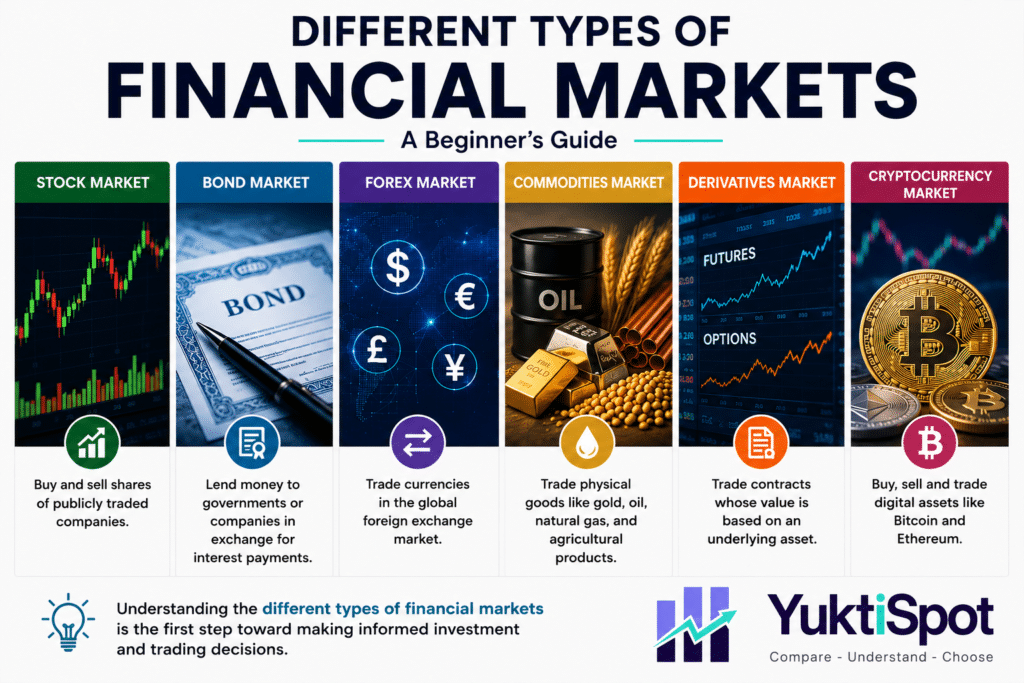
Different types of financial markets are at the heart of the global economy. Every day, individuals, companies and institutions use them to buy and sell assets, raise capital, manage risk or look for investment opportunities.
However, the term “financial market” covers much more than the stock market. Stocks, bonds, currencies, commodities and derivatives operate in different environments and respond to different economic forces.
Understanding the different types of financial markets is therefore an important first step for anyone interested in investing or trading. Before choosing a market, beginners should also understand the importance of building a clear trading strategy.
The market you trade can also determine which day trading software and analysis tools are most appropriate for your strategy.
What Is a Financial Market?
The different types of financial markets are a system where buyers and sellers exchange financial assets or contracts. These transactions may take place on organized exchanges or through decentralized networks.
Financial markets perform several important functions. They allow companies and governments to raise capital, give investors opportunities to allocate their money and help market participants manage financial risk.
The products available vary considerably. Investor.gov, the educational website of the U.S. Securities and Exchange Commission, lists stocks, bonds, funds and alternative investments among the many types of investment products available to investors.
Understanding what is actually being traded makes it easier to distinguish between the main markets.
What Are the Different Types of Financial Markets?
Understanding the different types of financial markets makes it easier to see why each market attracts different participants, strategies and levels of risk.
1. Stock Market
The stock market allows investors to buy and sell shares of publicly traded companies. When you purchase a stock, you acquire a small ownership interest in that company.
Stock prices can move according to company performance, economic conditions, interest rates and investor expectations.
Major exchanges such as the New York Stock Exchange and Nasdaq provide organized marketplaces for stocks, although trading is now largely electronic.
2. Bond Market
The bond market is based on debt rather than ownership.
Governments, companies and other organizations issue bonds to borrow money. Investors purchasing those bonds effectively lend money to the issuer in exchange for interest payments and, under normal conditions, repayment of the principal at maturity.
Bonds can have very different levels of risk depending on the issuer, maturity and economic environment.
3. Forex Market
The foreign exchange market, usually called forex or FX, is where currencies are exchanged.
Unlike a centralized stock exchange, forex operates through a global network of banks, brokers and other market participants. Currencies are quoted in pairs such as EUR/USD or GBP/USD.
Forex attracts many traders because of its liquidity and extensive trading hours. However, leverage can significantly amplify both gains and losses. Anyone considering this market should understand how to choose a trading broker as well as the risks associated with leveraged trading.
4. Commodities Market
Commodity markets cover physical resources such as gold, silver, oil, natural gas and agricultural products.
Market participants can gain exposure to commodities in several ways, including spot transactions and derivative contracts.
Prices may react strongly to supply and demand, weather conditions, geopolitical developments or changes in global economic activity.
5. Derivatives Market
Derivatives are financial contracts whose value depends on an underlying asset, index or other reference.
Futures and options are among the best-known examples. They can be used for speculation, but they also play an important role in hedging risk.
For example, futures contracts can help producers or businesses reduce their exposure to future commodity price movements. The U.S. Commodity Futures Trading Commission explains that futures markets are used both by commercial participants seeking to hedge price risk and by speculators seeking to profit from price changes.
Derivatives can be complex and may involve leverage, making risk management particularly important.
6. Cryptocurrency Market
Cryptocurrency markets allow participants to exchange digital assets such as Bitcoin and Ethereum.
They operate differently from traditional securities markets and can trade continuously rather than following conventional exchange hours.
Crypto markets can also experience substantial volatility. Beginners should therefore avoid assuming that experience with stocks, forex or another asset class automatically transfers to digital assets.
The table below compares the different types of financial markets by their main instruments and typical characteristics.
Different Types of Financial Markets at a Glance
| Market | What is traded? | Example |
|---|---|---|
| Stock market | Company shares | Apple shares |
| Bond market | Debt securities | Government bonds |
| Forex market | Currencies | EUR/USD |
| Commodities market | Raw materials | Gold, oil |
| Derivatives market | Financial contracts | Futures, options |
| Cryptocurrency market | Digital assets | Bitcoin |
Although these different types of financial markets are connected, their structure, risks and price drivers can differ significantly.
Which Financial Markets Are Most Relevant for Traders?
There is no single market that suits every trader.
Stock traders may focus on company results and broader economic conditions, while forex traders often monitor currencies, interest rates and monetary policy. Commodity traders may pay particular attention to supply conditions, and derivatives traders need to understand the contracts they trade.
Liquidity, volatility, trading hours, transaction costs and leverage can all influence the choice of market.
This is why learning risk management in trading is just as important as learning how to identify opportunities.
Which Financial Market Should a Beginner Choose?
Beginners do not need to trade every available market. In fact, focusing initially on one market can make it easier to understand how prices behave and how risk should be managed.
Before choosing, consider what is being traded, when the market is active, how volatile it tends to be and whether leverage is involved.
Whatever market you choose, understanding trading psychology can help you recognize how fear, FOMO and impulsive decisions affect the way you trade.
Understanding the different types of financial markets provides the foundation. The next step is not simply finding the market with the greatest potential return, but choosing one whose characteristics you understand and developing a disciplined approach to it.
Different types of financial markets : Final Thoughts
Understanding the different types of financial markets is a useful first step toward finding the environment that best matches your goals, experience and trading style. Stocks, bonds, forex, commodities and derivatives each operate differently, but the principle remains the same: understand the market before deciding how to trade it.
As your experience grows, you can refine your strategy, choose the right tools and focus on the markets that genuinely suit the way you trade.