
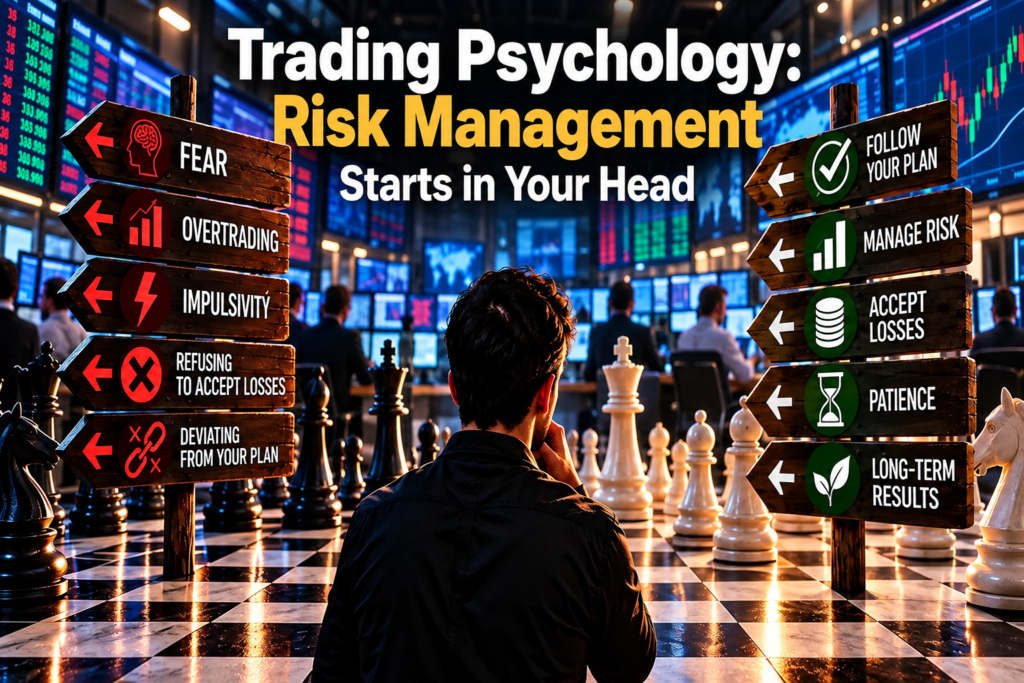
Many people start trading to make money, become financially independent, or take control of their lives. But what happens when fear, ego, or the urge to recover losses begins to control their decisions? Behind the charts, another battle is taking place: the battle to manage risk. And this is where trading psychology comes into play. It refers to the emotions, beliefs, and mental habits that influence how traders make decisions, react to losses, and deal with uncertainty. Because knowing how to protect your capital is one thing. Being able to follow your own rules when emotions take over is another.
Trading Psychology: Inside the Mind of a Risk Manager
8:30 a.m. In a trading room, the screens light up. Prices move across the monitors. Traders watch their positions and search for the next opportunity.
A little farther away, another professional is examining the same numbers. But he isn’t trying to calculate how much money the team could make today. He wants to know how much it could lose.
What would happen if the markets suddenly collapsed? If several positions moved against the team simultaneously? If volatility made it impossible to exit at the expected price? This professional is a risk manager.
His job is to monitor market exposure, assess potential losses, and ensure that trading decisions remain compatible with the capital and resources available. He doesn’t claim to predict the future. He considers what could go wrong. And when risk becomes excessive, he must be able to sound the alarm. But that raises an important question :
Trading psychology: Who Protects Your Capital?
Who plays that role when you’re sitting alone in front of your screen?
You’ve just spotted an opportunity in gold. Your analysis looks convincing. The price is approaching your expected entry level. You’re ready to place a trade. But have you calculated how much that trade could cost you? And if you already have two open positions, do you know your total exposure?
Risk management in trading is the discipline of controlling financial exposure, limiting potential losses, and protecting enough capital to continue trading. It involves decisions about position sizing, stop-loss levels, leverage, total account exposure, and the amount of money you are prepared to lose. In a financial institution, traders don’t necessarily determine all their risk limits themselves. Dedicated teams may monitor positions, assess exposures, and enforce trading procedures.
At home, however, everything rests on your shoulders. You are the analyst, the trader, the risk manager, and the supervisor. You wear every hat. And those different roles don’t always agree. The analyst sees an opportunity. The trader wants to take it. The risk manager considers what will remain in the account if the trade fails.
Which one do you listen to?
Trading psychology becomes especially important when these competing roles lead to conflicting decisions.
The Grasshopper and the Ant: Two Attitudes Toward Risk

The grasshopper thinks about today’s opportunity. The market move that must not be missed. The profit that could change the entire week.
The ant also thinks about tomorrow. It knows there will be other trading sessions, other opportunities, and probably other losses.
But this isn’t simply a choice between courage and caution. Trading always involves taking risks.The real question is how much risk your capital can actually withstand.
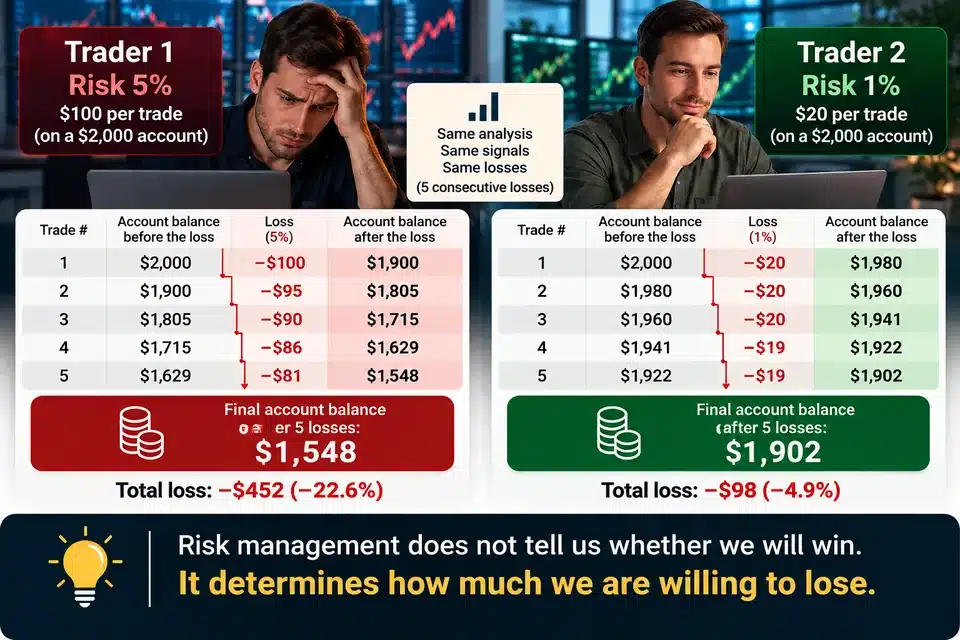
Imagine two traders, each starting with $2,000. The first risks 5% of the account on each trade, initially $100. The second risks just 1%, initially $20. Their market analysis could be identical. Their entry signals could be exactly the same. But after five consecutive losses, with risk recalculated on the remaining account balance, their results would be very different.
| Risk per trade | Starting capital | Capital after 5 losses | Total loss |
|---|---|---|---|
| 5% | $2,000 | $1,548 | $452 |
| 1% | $2,000 | $1,902 | $98 |
Figures rounded to the nearest dollar. The example assumes each loss reaches the planned risk amount, without additional execution costs or slippage.
This is where trading psychology meets mathematics: accepting smaller losses today may help preserve the capital needed for tomorrow.
The 1% figure is not a universal rule. And reducing exposure cannot turn an unprofitable strategy into a profitable one. But this example reveals an essential difference. Risk management doesn’t tell us whether we will win. It determines how much we are willing to lose.
Trading psychology: Why Do We Want to Win So Badly?
Impeccable suits. Giant screens. Phones ringing constantly. Money, power, adrenaline. That’s roughly the image many people have of a professional trader. Hollywood has played a major role in creating it.
In The Wolf of Wall Street, Jordan Belfort represents a world of spectacular wealth and excess. But his story concerns a stockbroker involved in fraudulent practices, not a representative example of professional trading.
Still, the image remains attractive. Making money from a computer. Working from anywhere. Answering to no one. Who hasn’t been tempted by that possibility?
But money doesn’t explain everything. There’s the satisfaction of understanding financial markets. The intellectual challenge. The freedom to make your own decisions. And sometimes there’s something more personal: the desire to prove to yourself that you can succeed.
The problem begins when we confuse freedom with having no limits. Nobody forces you to open another position. Nobody requires you to recover yesterday’s loss. Nobody tells you to sit in front of your screens until midnight.
So why is it sometimes so difficult to stop? Why can an activity chosen in pursuit of independence end up occupying every corner of our minds?
Trading psychology helps explain why the desire to recover losses can sometimes become stronger than the commitment to follow a trading plan.
What Do U.S. Statistics Tell Us About Trading Risk?
According to the U.S. Commodity Futures Trading Commission (CFTC), approximately two out of three retail forex trading accounts lose money each quarter. This figure concerns retail foreign exchange trading, not every trader or every financial market.
Nevertheless, it reminds us that the promise of quick profits can conceal substantial risks. Confidence alone provides no financial protection.
Meanwhile, Americans remain deeply involved in financial markets. According to Gallup’s 2025 stock ownership survey, 62% of U.S. adults reported owning stocks, directly or through mutual funds and retirement accounts, compared with 55% in 2020.
Stock ownership is not the same as active trading, and these figures describe different populations and activities. But together, they highlight an important contrast. Financial markets play a significant role in American financial life, while speculative trading continues to expose participants to substantial losses.
And this is precisel why Trading Psychology in risk management matter. Accessing the markets has become relatively simple. Learning to control risk is an entirely different challenge.
Trading psychology: A Chess Game Against Yourself?
In chess, a beginner often focuses on the move they want to make. An experienced player also considers how the opponent might respond. What could be lost? What move might come next? Is a promising attack worth sacrificing a piece?
Traders need to develop a similar way of thinking.They prepare for the favorable scenario, but also for the possibility that their analysis is wrong.
There is one important difference. In chess, the pieces are visible. In financial markets, the intentions of other participants and future events are not. We cannot predict everything. And more importantly, we cannot judge the quality of a decision solely by its outcome.
One trader ignores every rule, takes excessive risk, and makes $300. Another follows a carefully prepared plan and loses $20. Which one made the better decision? This distinction becomes particularly important when losses accumulate.
Imagine you’ve just experienced four consecutive losing trades. Your strategy produces another entry signal. Will you take the trade normally? Will you skip it because you’re afraid of losing again? Or will you double your position size to recover the money?
It’s often at this point that the real difficulty is no longer visible on the chart. It lies in how we react. Understanding trading psychology means learning to distinguish a calculated decision from an emotional reaction disguised as an opportunity.
And what if, after spending so much time searching for a better trading strategy, we finally started examining our own decisions?
Five Trading Psychology Books That Reveal What’s Happening Inside a Trader’s Mind
Trading books often promise new strategies, indicators, or techniques to anticipate market movements. But some books explore a more fundamental question: Why is it so difficult to apply what we already know?
The following five authors offer valuable perspectives on trading psychology, decision-making, and capital preservation. Their lessons help us understand why knowing how to manage risk and actually doing it are two very different things.
These trading psychology books approach the same challenge from different perspectives: how to make better decisions when uncertainty, money, and emotions collide.
1. Mark Douglas — Trading in the Zone
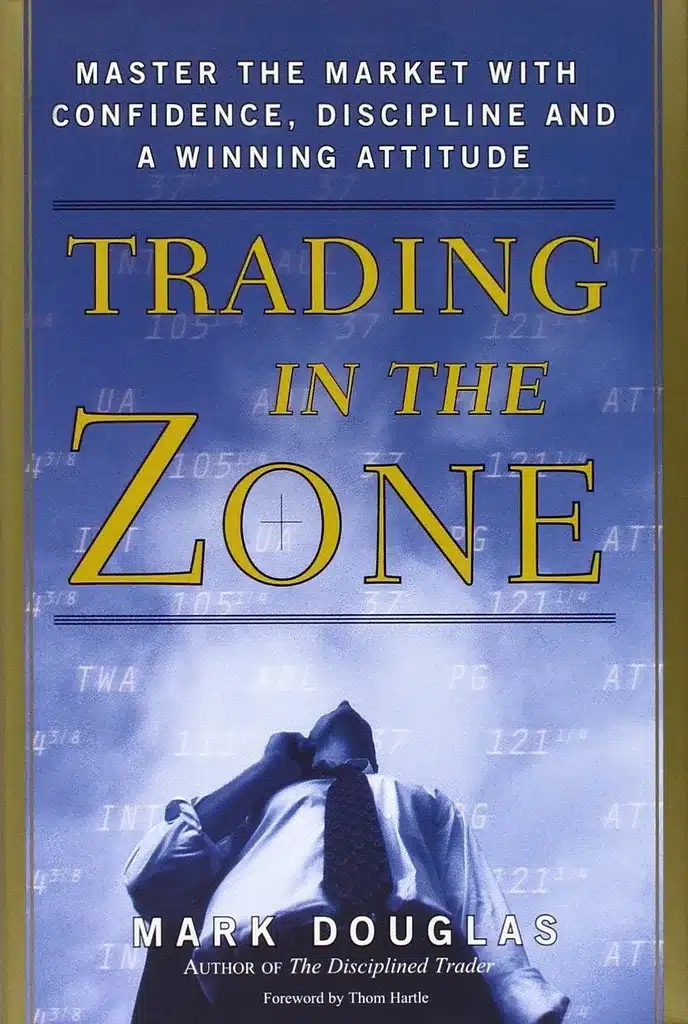
“Anything can happen.”
— Mark Douglas, Trading in the Zone, Chapter 7, p. 121.
Mark Douglas explores the psychological challenges of trading in Trading in the Zone. One of his central arguments is that successful trading requires accepting uncertainty rather than constantly trying to eliminate it. This sounds obvious. Yet how many traders enter a position secretly hoping that their analysis will protect them from taking a loss?
Douglas identifies five fundamental truths about probabilistic thinking in trading. In essence, they teach us that:
- Anything can happen. No market scenario is guaranteed.
- You don’t need to predict every movement. A viable strategy depends on a statistical advantage rather than certainty.
- Wins and losses do not follow a predictable sequence. A losing streak does not automatically mean that a strategy has stopped working.
- A trading edge represents probability, not a promise.
- Every market situation is unique. A familiar setup may produce a different outcome.
These principles appear in Trading in the Zone, page 121, where Douglas explains the foundations of a probabilistic trading mindset.
The third principle is particularly important. You’ve tested a strategy that appears to have a genuine statistical advantage. Yet after four consecutive losses, you begin to doubt everything. Should you change your indicators? Increase your next position? Abandon the strategy altogether?
Douglas encourages traders to recognize that a losing trade may simply belong to a normal statistical sequence. Of course, this doesn’t mean blindly trusting a strategy forever. Its performance must still be evaluated over a meaningful sample of trades, including trading costs. But accepting uncertainty changes our relationship with failure.
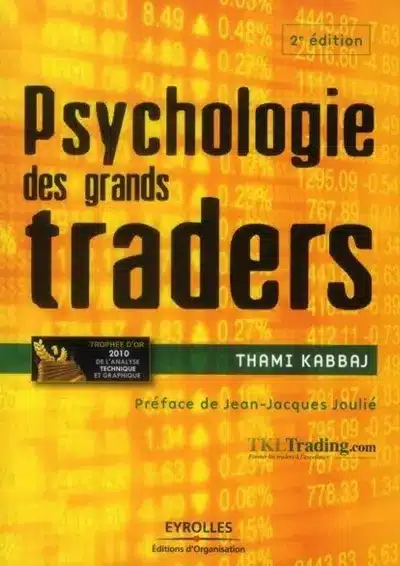
2. Thami Kabbaj — Psychologie des grands traders
And you? When you open a position, do you genuinely accept the risk, or are you simply hoping you won’t be wrong?
“Large losses generally begin as small losses that were poorly managed.”
“Les grosses pertes sont généralement de petites pertes qui ont été mal gérées.”
— Psychologie des grands traders, section Comment récupérer après une grosse perte ?
In Psychologie des grands traders, French trading author Thami Kabbaj examines the psychological mechanisms that influence trading decisions, including cognitive biases, overconfidence, impulsiveness, and the tendency to underestimate risk. The book is only published in French. Its second edition also credits Jean-Jacques Joulié.
His work encourages us to examine the relationship between our intentions and our actual behavior. We may understand the importance of stop-loss orders and capital protection. But understanding a rule doesn’t guarantee that we will follow it when money is at stake.
Imagine that you planned to lose no more than $30 on a trade. But when the price approaches your stop-loss, you move it farther away. You’re convinced the market will reverse. The loss reaches $60. Then $100. You’re no longer managing a trade. You’re trying to avoid being wrong.
And that brings us back to a simple question: How many times do we search for a new strategy when we haven’t even followed the previous one?
3. Jack D. Schwager — Market Wizards
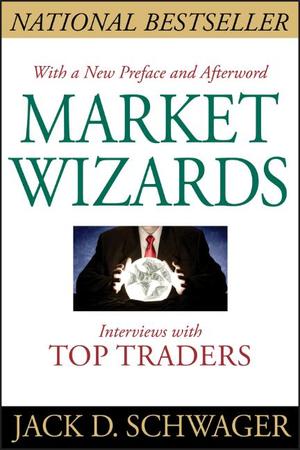
“Don’t focus on making money; focus on protecting what you have.”
— Paul Tudor Jones, interviewed by Jack D. Schwager in Market Wizards, The Art of Aggressive Trading.
In Market Wizards: Interviews with Top Traders, Jack D. Schwager introduces readers to some of the most successful traders through a series of interviews. Among them is Paul Tudor Jones, known for his strong emphasis on controlling losses and preserving capital.
One of the central lessons from his approach is that trading is not simply about finding profitable opportunities. It is also about surviving the periods which reverses the priorities of many beginners.
Consider a simple example. You start with $2,000. After several successful weeks, your account reaches $2,600. Your confidence grows. You increase your position sizes. Your risk limits become less strict. Within a few trades, you’ve given back a large portion of your profits. What changed? Perhaps the market. But perhaps your behavior changed too.
Success can create its own psychological traps. After a winning streak, traders may begin to believe they understand the market better than they actually do. They may take larger positions, overlook warning signs, or become less willing to accept small losses.
Protecting capital after a winning streak can require just as much discipline as protecting it after a series of losses.
4. Daniel Kahneman — Thinking, Fast and Slow
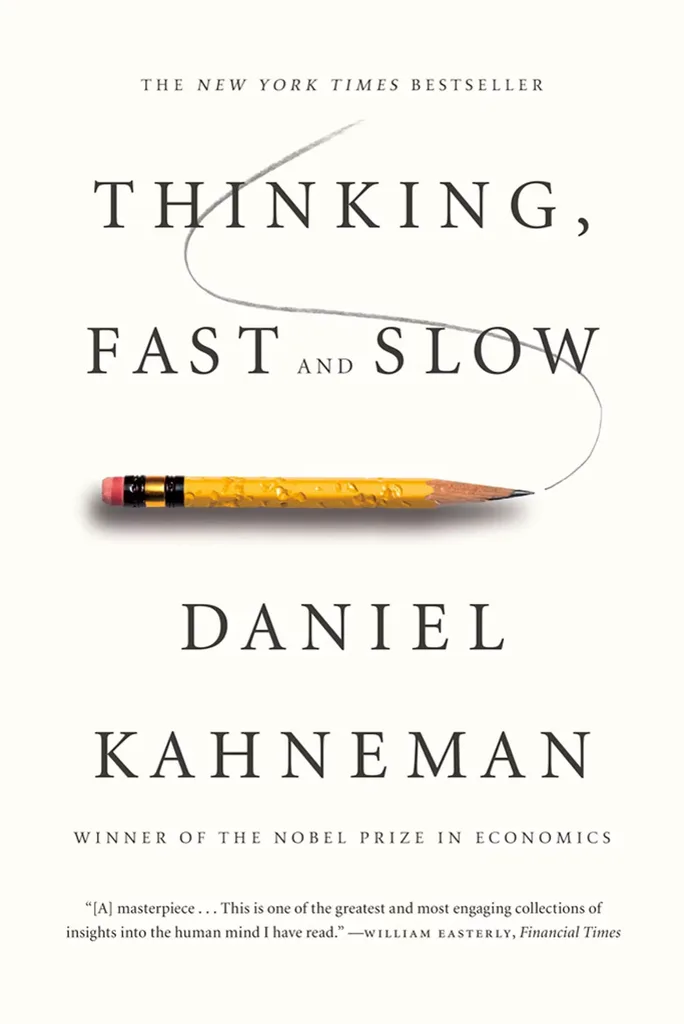
“Nothing in life is as important as you think it is when you are thinking about it.”
— Daniel Kahneman, Thinking, Fast and Slow, Chapter 38.
Why do losses sometimes seem to matter so much more than gains? In Thinking, Fast and Slow, psychologist and Nobel Prize laureate Daniel Kahneman examines the mechanisms that influence human judgment, often without our conscious awareness. He describes two modes of thinking:
- System 1: Fast, intuitive, and automatic. It produces immediate impressions and reactions with little deliberate effort.
- System 2: Slower and more analytical. It requires attention and deliberate reasoning.
This distinction becomes especially relevant when you’re sitting in front of a trading screen. Imagine you’ve just lost $80. Only a few minutes earlier, you were calmly following your strategy. But now one thought dominates your mind: You need to get that money back. You notice another potential opportunity. You enter more quickly than usual. You even increase your position size slightly. Why?
Because your decision is no longer guided solely by market analysis. It is also being influenced by the emotional impact of the previous loss. Kahneman describes a related psychological phenomenon known as the focusing illusion.
The $80 loss is real. But the urgency you feel to recover it may not be justified. Before opening another position, ask yourself:
If I hadn’t lost that money twenty minutes ago, would I be making exactly the same decision?
If the answer is no, your next trade may be driven less by your strategy than by your desire to repair an uncomfortable experience. This is where trading psychology becomes inseparable from risk management.
5. Alexander Elder — Trading for a Living
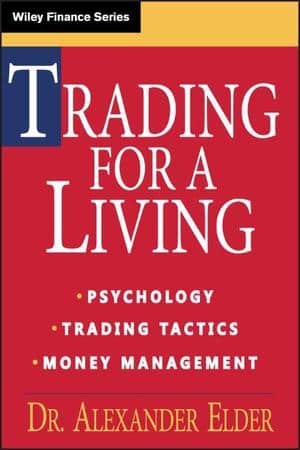
“The market does not know you exist. You can do nothing to influence it. You can only control your behavior.”
— Alexander Elder, Trading for a Living, Chapter 11, p. 39.
In Trading for a Living, psychiatrist and trader Alexander Elder addresses a reality that many beginners discover through experience. Understanding the markets is not enough to become a consistently disciplined trader. His approach brings together three essential elements:
Mind, Method, and Money.
Trading psychology, a structured analytical method, and sound money management must work together. After all, what is the value of identifying an excellent trading opportunity if one reckless decision can destroy several weeks of progress?
We spend enormous amounts of time trying to anticipate market movements. Will prices rise? Will they fall? Will gold return to our entry level? But once a position is open, we cannot force the market to move in our preferred direction.
What we can control is how much we risk. We can determine our position size, establish a maximum acceptable loss, follow our trading plan, and choose not to trade when conditions are unsuitable.
Consider an example. You’ve identified a promising setup in gold. Your analysis looks convincing, but the stop-loss required by the setup would expose your account to a loss greater than your usual risk limit. You have two options :
Reduce your position size so that the potential loss remains within your limit. Or skip the trade entirely.
That is where money management associated with trading psychology becomes meaningful. The objective is not to predict the market perfectly. It is to preserve your ability to continue trading even when your analysis turns out to be wrong. We cannot control financial markets, but we can learn to control our decisions.
How Can Trading Psychology Become a Daily Practice?
Reading these books may change how we understand trading. But what remains of their lessons when the market suddenly accelerates, a position moves against us, and the urge to react becomes overwhelming? This is where reflection must turn into action.
Four questions can help guide the process.
1. Before Entering: How Much Are You Willing to Lose?
Before opening a position, determine how much of your capital you are prepared to risk. A useful starting point is to calculate the distance between your entry price and your stop-loss, then adjust the position size accordingly.
For example, with a $2,000 account and a hypothetical 1% risk limit, the planned maximum loss would be $20. That doesn’t guarantee the actual loss will be limited to $20. Slippage, gaps, and execution costs can produce a worse result.
But defining your intended exposure before entering the market is fundamentally different from deciding how much pain you can tolerate after the trade turns against you.
2. During the Session: Do You Know Your Total Risk?
A single position may appear manageable. But what happens when you open several trades simultaneously?
Imagine holding three positions that each expose your account to a potential loss of $20. Your combined planned risk could reach $60, even before considering the possibility that correlated markets may move against you at the same time.
Risk management is not only about individual trades. It is also about understanding your total exposure.
3. After a Loss: What Do You Do With Your Frustration?
A losing trade may be part of a perfectly reasonable strategy. But the emotional reaction that follows can create a second, unnecessary loss.
Do you immediately search for another opportunity? Increase your position size? Move your stop-loss? Or can you accept the result and wait for the next valid signal? This is one of the most practical applications of trading psychology: recognizing when frustration is influencing your decisions before it affects your capital.
Sometimes, the best risk management decision is simply not to trade.
4. After the Session: What Have You Actually Learned?
A winning trade is not necessarily a good decision. A losing trade is not necessarily a mistake. To understand the difference, we need to return to the facts.
Why did you enter?
What risk had you planned?
Did you follow your rules?
What caused you to change your behavior?
This is precisely why understand why keeping a free trading journal can be so valuable. You just need to import your MetaTrader 5 trading history and examine your results alongside your trading behavior.
Over time, reviewing your decisions may reveal patterns that are difficult to recognize in the moment: increasing position sizes after a win, moving stop-loss orders after a loss, or taking unnecessary trades out of boredom.
A journal cannot turn an unprofitable strategy into a profitable one. But it can help you determine whether you are actually following your own rules.
Can Automated Trading Eliminate the Problem?
A trading robot doesn’t experience fear or euphoria. That makes automation an attractive idea. Why not delegate trading decisions to a machine and remove emotions from the process? Unfortunately, the answer isn’t that simple.
An algorithm remains exposed to market risk, weaknesses in its strategy, and the settings chosen by its user.
Who determines the level of risk? Who monitors maximum drawdown? Who intervenes when market conditions change?
Before automating your trades, it is essential to understand how to choose an automated trading system and verify its performance.
Automation may reduce certain human execution errors, but it cannot eliminate market risk or replace responsible capital management. A trading bot may follow its programmed rules perfectly. But who decided whether those rules were reasonable in the first place?
Trading Psychology : The Final Thought
Perhaps you started trading to make money, become independent, or build an activity around your own schedule. Then came the first losses. The doubts. The moments of excitement. And that temptation to recover immediately what the market had just taken away.
Perhaps you’ve changed indicators, strategies, or financial instruments several times. But have you spent as much time examining the way you make decisions? That is the deeper purpose of trading psychology: not to eliminate uncertainty, but to prevent our reactions to uncertainty from controlling our financial decisions.
Trading teaches us to read charts. It can also force us to examine our relationship with money, uncertainty, and failure. That awareness doesn’t guarantee success or profitability. But it may help prevent an ordinary mistake from becoming a catastrophic loss.
Ultimately, trading psychology is not just about understanding emotions, and risk management is not just about calculating percentages or placing stop-loss orders. It is about accepting responsibility. The responsibility to protect your capital from market risks, but also from the decisions you make when emotions take over.
You may not have a risk management team reminding you of your limits. You may have nobody telling you when to stop. So the next time an opportunity appears on your screen, ask yourself one final question:
“When you’re about to make a trading decision, is your priority to win this particular trade, or to protect enough capital to keep trading tomorrow?”