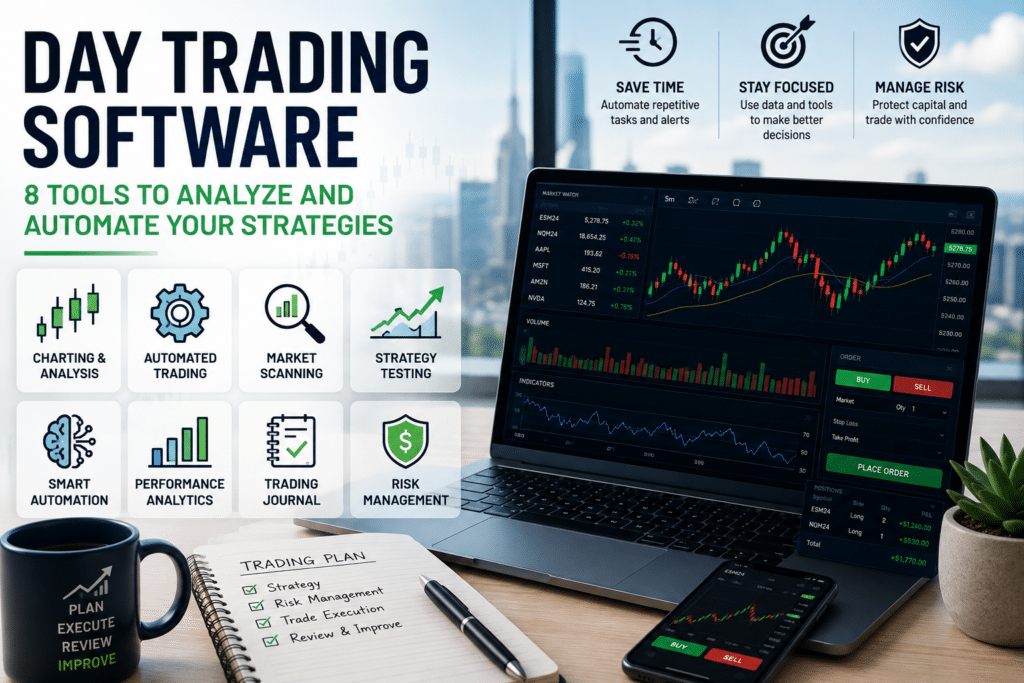
Choosing the best trading platform for day traders is not simply a matter of finding the broker with the lowest advertised commission. Day trading places particular demands on a platform: fast order entry, reliable execution, advanced charting, real-time data and effective risk-management tools can all influence the trading experience.
The right choice also depends on what you trade and how you trade. A platform should support your trading strategy, whether you focus on stocks, futures or options. A futures trader may have very different requirements from someone trading stocks or options.
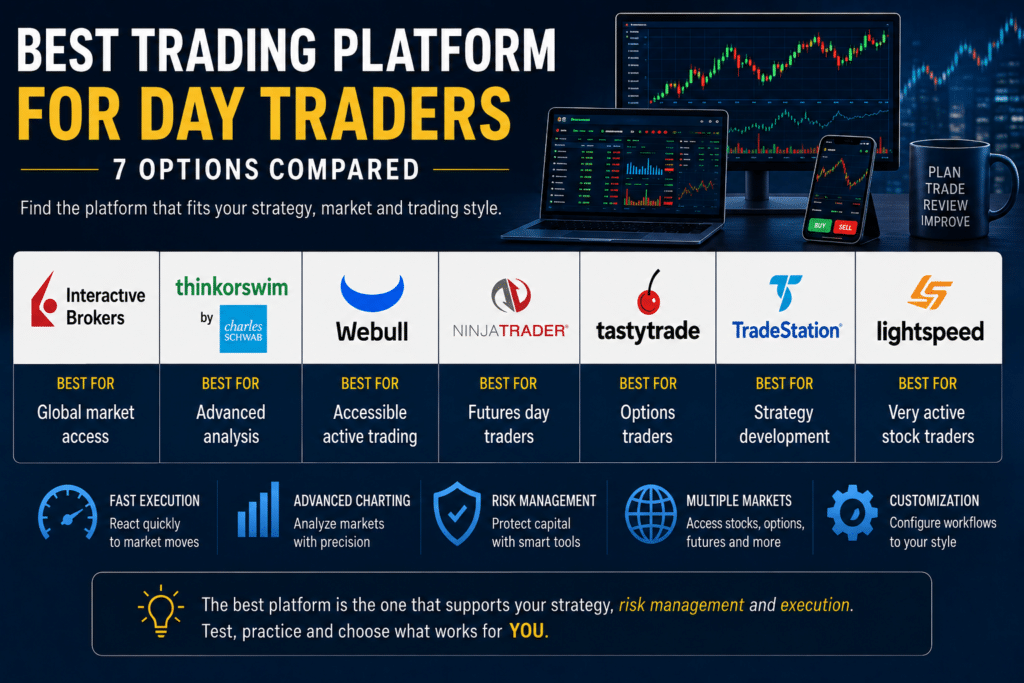
Rather than declaring one platform universally superior, we compared seven established and specialist platforms according to the type of trader they may suit best.
Best Trading Platforms for Day Traders at a Glance
| Platform | Best For | Main Strength |
|---|---|---|
| Interactive Brokers TWS | Global market access | Multi-asset trading and advanced tools |
| thinkorswim | Advanced analysis | Charting and trading tools |
| Webull | Accessible active trading | Flexible desktop, web and mobile experience |
| NinjaTrader | Futures day trading | Futures-focused trading environment |
| tastytrade | Options traders | Options analysis and strategy tools |
| TradeStation | Strategy development | Scanning, testing and automation |
| Lightspeed Trader | Very active stock traders | Direct-access style tools and fast order entry |
These platforms serve different types of traders, so the best choice depends on your market, experience, trading frequency and strategy.
1. Interactive Brokers TWS – Best for Global Market Access
Interactive Brokers’ Trader Workstation (TWS) is designed for active traders who want access to a broad range of markets and instruments from a single environment.
Its main advantage is depth. TWS combines sophisticated order types, market data, charting and risk-management capabilities with extensive international market access.
That makes it particularly interesting for experienced day traders who trade multiple asset classes or markets.
The trade-off is complexity. New traders may find the interface less intuitive than simpler web or mobile-first platforms.
| ✓ BEST FOR | ⚠ MAIN LIMITATION |
|---|---|
| Experienced traders requiring broad market access | Steeper learning curve due to extensive tools and settings |
2. Thinkorswim – Best for Advanced Analysis
Schwab’s thinkorswim has long been associated with active trading and technical analysis.
The desktop platform combines customizable charts, technical studies, order-management tools and paper trading through paperMoney. Traders can therefore explore setups and practice execution before committing real capital.
Its analytical depth makes thinkorswim particularly attractive to traders who want to conduct much of their analysis and execution within the same environment.
Schwab currently offers online listed equity trades at $0 commission, while options carry a per-contract fee. Conditions and product-specific charges should always be checked before opening an account.
Explore thinkorswim trading tools at Charles Schwab
| ✓ BEST FOR | ⚠ MAIN LIMITATION |
|---|---|
| Traders who prioritize technical analysis and advanced charting | The desktop platform can initially feel complex for beginners. |
3. Webull – Best for Accessible Active Trading
Webull provides desktop, web and mobile platforms with an interface that is generally more approachable than some professional trading terminals.
Its desktop platform includes customizable layouts, technical indicators, screeners, real-time market information and tools for monitoring trading performance.
This combination can make Webull an interesting bridge between beginner-oriented trading apps and more complex professional platforms.
It also supports extended-hours trading for eligible securities and offers tools designed specifically for active traders.
| ✓ BEST FOR | ⚠ MAIN LIMITATION |
|---|---|
| Accessible platform with solid active-trading features. | Fewer advanced tools for highly specialized traders. |
4. NinjaTrader – Best for Futures Day Traders
NinjaTrader stands apart because of its strong focus on futures trading.
For active futures traders, features such as advanced charting, order-flow analysis, market replay and depth-of-market tools can be particularly valuable.
Rather than trying to be the ideal platform for every type of investor, NinjaTrader concentrates heavily on an area where specialized execution and market-analysis tools matter.
That makes it one of the more relevant platforms to consider when day trading futures is the primary objective.
| ✓ BEST FOR | ⚠ MAIN LIMITATION |
|---|---|
| Active futures and micro-futures traders. | Less suitable as an all-in-one multi-asset platform. |
5. Tastytrade – Best for Active Options Traders
Options traders have different analytical requirements from traders simply buying and selling stocks.
Tastytrade addresses this with an interface and toolset strongly oriented toward options and derivatives. Traders can analyze positions, construct multi-leg strategies and visualize potential risk and reward before submitting an order.
The platform also supports futures and other products, but options remain one of its clearest strengths.
For traders whose day-trading approach involves options rather than primarily equities, this specialization can be more useful than choosing a general platform with only basic options functionality.
| ✓ BEST FOR | ⚠ MAIN LIMITATION |
|---|---|
| Active options and derivatives traders. | More complex than needed for stock-only traders. |
6. TradeStation – An Advanced Platform Worth Considering
TradeStation is an interesting alternative to the names that dominate many mainstream comparisons.
Its desktop environment includes charting, market-depth tools, scanners and RadarScreen, which allows traders to monitor large groups of securities and identify conditions in real time.
Another important feature is EasyLanguage, TradeStation’s environment for creating customized indicators and trading strategies.
This makes the platform particularly interesting for traders who want to move beyond manual chart analysis and begin testing or automating clearly defined trading rules.
That does not mean automation automatically creates a profitable strategy. Technology works best when it supports a well-defined trading strategy rather than replacing one.
| ✓ BEST FOR | ⚠ MAIN LIMITATION |
|---|---|
| Technical traders focused on scanning and automation. | More advanced than needed for simple order execution. |
7. Lightspeed Trader – Under the Radar
Lightspeed Trader is probably the least mainstream name in this selection, but that is precisely why it deserves attention.
The platform is aimed primarily at highly active traders rather than casual investors. It provides features such as Level II market data, customizable hotkeys, scanners and advanced order-entry tools.
For a trader executing many stock trades during a session, the ability to configure order entry and monitor markets efficiently can be more valuable than having a visually simplified interface.
Lightspeed is therefore an example of why the best trading platform for day traders is not necessarily the platform with the largest consumer brand.
However, this specialization comes at a price. Lightspeed publishes account minimums and platform costs that can make it less attractive for occasional or beginning traders.
See Lightspeed Trader platform features and requirements
| ✓ BEST FOR | ⚠ MAIN LIMITATION |
|---|---|
| Very active and experienced equity traders. | Higher costs and requirements for beginners. |
What Is the Best Trading Platform for Day Traders?
There is no single answer.
The best trading platform for day traders depends largely on what the trader actually needs to accomplish.
For example:
- A trader accessing multiple international markets may prefer Interactive Brokers TWS.
- Someone focused heavily on technical analysis may favor thinkorswim.
- A trader wanting a more accessible active-trading environment may consider Webull.
- Futures specialists may find NinjaTrader more appropriate.
- Active options traders may prefer tastytrade.
- Traders developing or automating systematic strategies may appreciate TradeStation.
- Highly active stock traders may find Lightspeed Trader worth investigating.
The question is therefore not simply, “Which platform has the most features?” but rather, “Which features does my trading strategy actually require?”
How We Compare Day Trading Platforms ?
When comparing the best trading platform for day traders, we focus on the features that can directly affect analysis, execution and risk management.
Execution and Order Tools
Day traders frequently enter and exit positions within short periods. Order types, execution controls, hotkeys and the ability to manage positions efficiently can therefore matter significantly.
Charting and Market Analysis
Technical indicators, multiple timeframes, drawing tools, scanners and real-time market information can help traders identify and monitor setups.
More features are not automatically better. The objective is to have the tools required by the strategy without creating unnecessary complexity.
Trading Costs
Cost is an important consideration when choosing the best trading platform for day traders, because commission-free stock trading does not necessarily mean trading is completely free.
Depending on the platform and product, traders may encounter regulatory fees, options contract charges, futures commissions, market-data subscriptions, margin costs or platform fees.
For an active trader placing many transactions, relatively small costs can accumulate.
Markets and Instruments
A platform that is excellent for U.S. equities may be unsuitable for futures, options or international markets. Finding the best trading platform for day traders therefore requires checking that the platform supports the markets and instruments used by your strategy.
Before choosing a platform, determine which instruments you actually intend to trade.
Reliability and Risk Management
Platform stability becomes particularly important when trades are short-term and markets are moving quickly.
Order controls, position monitoring, alerts and risk-management features should therefore be considered alongside charting and execution.
This becomes even more important for traders operating through a prop firm trading program, where daily-loss or drawdown limits can determine whether an account remains active.
Demo and Testing Tools
Paper trading and simulation can help traders learn a platform and test execution procedures without immediately risking capital.
They can also be useful when moving from one platform to another, because identical trading strategies can require different workflows depending on the software.
Should Beginners Choose the Same Platform as Experienced Day Traders?
The best trading platform for day traders is not necessarily the same for beginners and experienced traders.
An experienced trader may value advanced order routing, APIs, extensive customization and dozens of analytical tools. A beginner can easily become overwhelmed by the same features.
New traders should generally prioritize a clear interface, reliable order management, educational resources and the ability to practice.
As experience develops, more sophisticated requirements may emerge.
This is another reason why selecting the best trading platform for day traders should be based on individual needs rather than simply choosing whichever platform has the longest feature list.
Final Thoughts
The best trading platform for day traders is ultimately the one that supports the trader’s market, strategy and execution requirements without adding unnecessary friction.
Interactive Brokers TWS and thinkorswim provide extensive tools for experienced traders, while Webull offers a more accessible active-trading environment. NinjaTrader and tastytrade stand out through their specialization in futures and options respectively.
TradeStation deserves consideration from traders interested in systematic strategy development, while Lightspeed Trader is an under-the-radar alternative for highly active stock traders who value specialized execution tools.
Before opening or funding an account, traders should verify current fees, market availability, regulatory conditions and platform requirements directly with the provider, as these can change.
Ultimately, choosing a platform is only one part of the process. Good technology can support disciplined trading, but it cannot replace a tested strategy, appropriate risk management and consistent execution.